
Five questions every leadership team should answer before the next security purchase
Here is a pattern we see constantly. A company has a close call, fails an audit question, or gets a tougher cyber insurance renewal. Someone buys a new security tool. Then it happens again, and they add another tool.
A few years later, the business has a stack of products, a growing bill, and nobody who can confidently say which risks are actually covered.
That is not a security problem. It is a planning problem. And as our new white paper, Strategic Security Planning: From Reactive Defense to Business Resilience, explains, ignoring it is getting more expensive.
The cost of reacting keeps climbing.
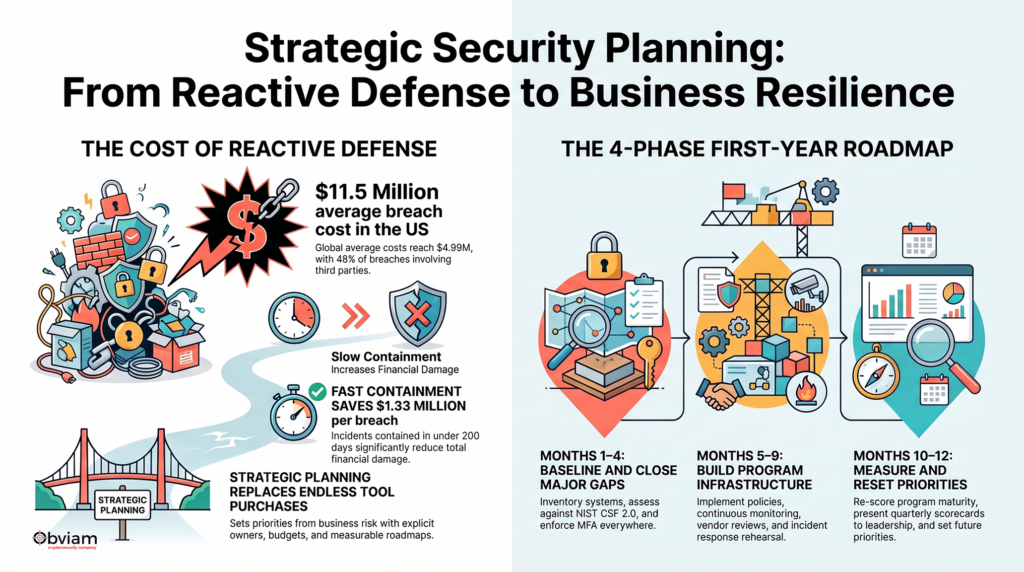
According to IBM’s 2026 Cost of a Data Breach Report, the average breach now costs a record $4.99 million worldwide and $11.5 million in the United States. Healthcare ($6.64 million) and financial services ($6.29 million) remain among the most expensive industries to be breached.
The way attackers get in is shifting, too. Verizon’s 2026 Data Breach Investigations Report found that 48% of breaches involved a third party, a 60% jump in a single year. Ransomware showed up in 48% of breaches, and small organizations made up 96% of ransomware victims.
The most useful number for business leaders may be this one: IBM found that breaches contained in under 200 days cost an average of $4.32 million, compared with $5.65 million for those that dragged on. Fast containment does not happen by accident. It comes from months of preparation.
 What strategic security planning actually means
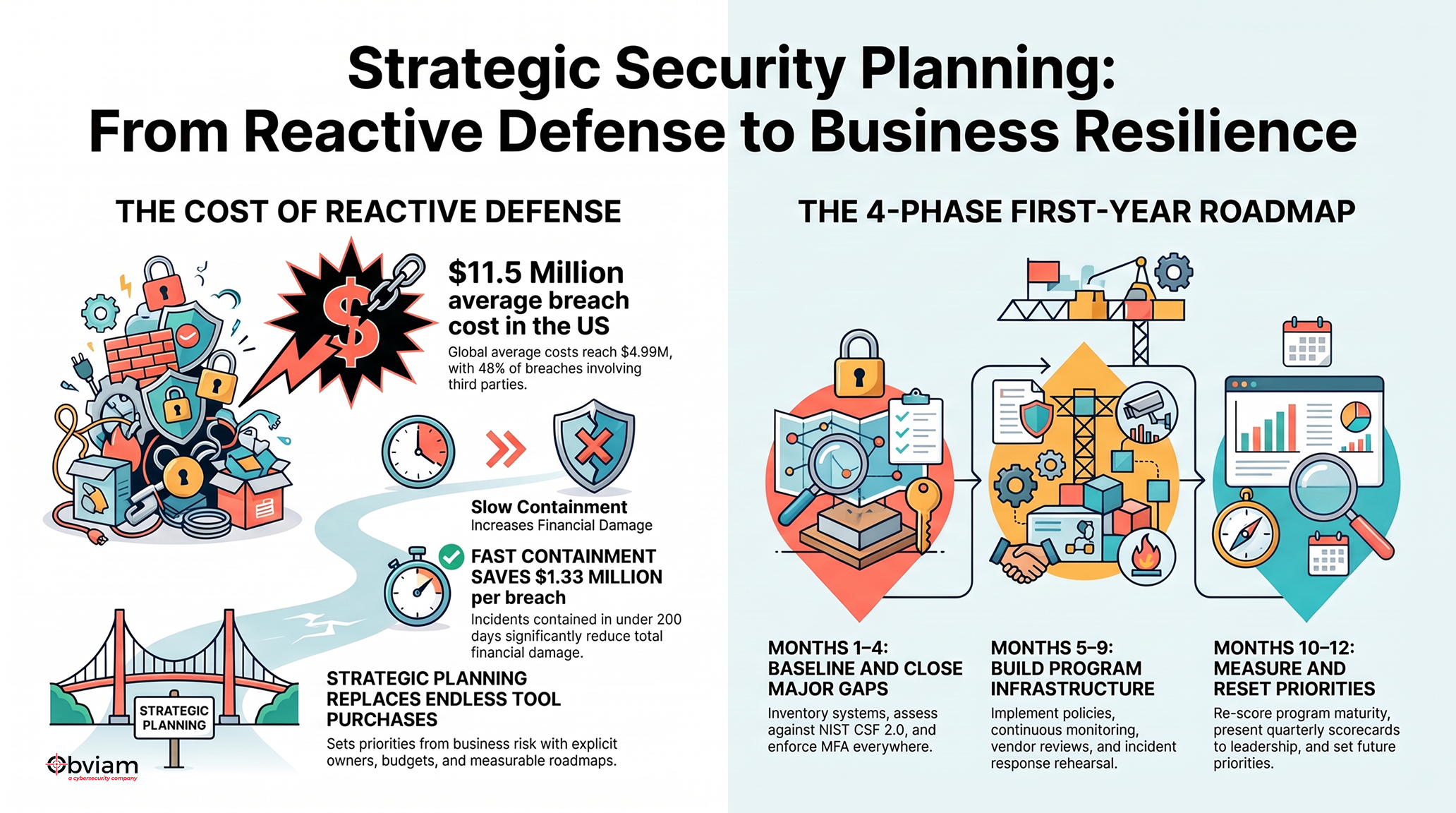
Strategic security planning is the practice of setting security priorities from business risk, documenting them in a funded multi-year roadmap, and reviewing progress against measurable outcomes at the leadership level.
In other words, the plan comes first, and the tools follow. It is also different from a one-time assessment. An assessment is a snapshot; a strategic plan turns that snapshot into decisions, owners, budgets, and dates.
The five questions leadership should answer.
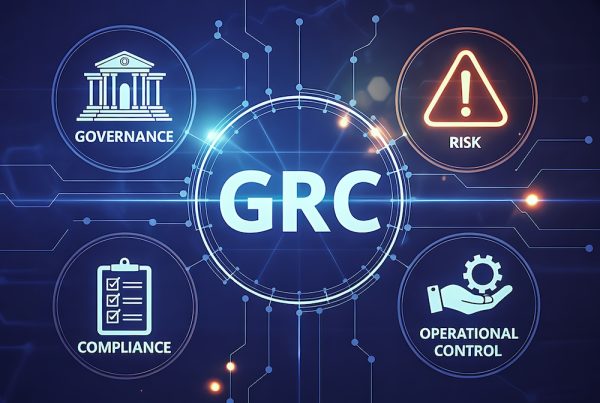
Obviam builds every security plan around five questions answered with the client’s leadership team. Each one maps to the NIST Cybersecurity Framework 2.0, the national standard auditors and insurers already recognize.
- What must we protect? The operations, data, systems, and connected devices the business cannot afford to lose.
- What could stop us? Likely threats, weak points, and exposure through vendors and other third parties.
- What must we prove? The regulations, contracts, and insurance requirements you need to show evidence for, such as HIPAA, the FTC Safeguards Rule, PCI DSS, or CMMC.
- What do we fund first? Controls ranked by business impact and cost, laid out in a dated roadmap.
- How will we know it’s working? Continuous monitoring, tested response and recovery, and a short leadership scorecard.
Above all five sits governance: leadership, not just IT, owns the answers. That shift alone changes security from a cost line into a business decision.
Don’t forget the devices hiding in plain sight.
Multifunction printers and copiers are full network computers. They store scanned documents, connect to email and file shares, and often run legacy firmware with default settings. Yet security assessments rarely include them.
Because Obviam is part of Modern Office Methods, which has managed print and imaging fleets since 1957, our planning covers the devices many security firms skip, including MFP hard drives, scan-to-email credentials, and print servers.
What a first-year roadmap looks like
A practical first year usually moves through four phases, each ending with a leadership checkpoint:
- Months 1–2, Baseline: assess against NIST CSF 2.0 and inventory systems, data, vendors, and devices.
- Months 3–4, Close major gaps: MFA everywhere, patching, privileged access, and backup testing.
- Months 5–9, Build the program: policies, monitoring, awareness training, vendor reviews and incident response rehearsal.
- Months 10–12, Measure and reset: re-score, report to leadership and set next year’s priorities.
Choosing the right partner
Most mid-sized organizations can’t justify a full-time chief information security officer. A partner can fill that role, but only if it plans with you rather than sells to you. Before you sign, ask who will act as your security leader, how recommendations will be ranked, which frameworks you’ll be mapped to, and what you’ll see on a quarterly scorecard. The white paper includes a full ten-question checklist.
The bottom line
Security spending without a plan buys activity, not resilience. The organizations that recover fastest from an incident are the ones that planned for it.
Questions? Email info@obviam.com or call 513-699-1111.
Sources
- Strategic Security Planning: From Reactive Defense to Business Resilience — Obviam white paper, October 2026 (replace link with landing page URL)
- Ten Takeaways from IBM’s 2026 Cost of a Data Breach Report — Baker Donelson
- 2026 Data Breach Investigations Report: Infographic for SMBs — Verizon
- Security FocusesRevealed in Verizon’s 2026 Data Breach Report — The National CIO Review
- Verizon DBIR 2026: Small Businesses Confront Escalating Cyber Risks — Cyber Readiness Institute
- Cybersecurity Framework 2.0 — NIST